
And other Dungeon Mastery Feels.
Lucky, D&D Player’s Handbook 5e, P.167
Taking a look on the internet, Lucky gets hate. But why?
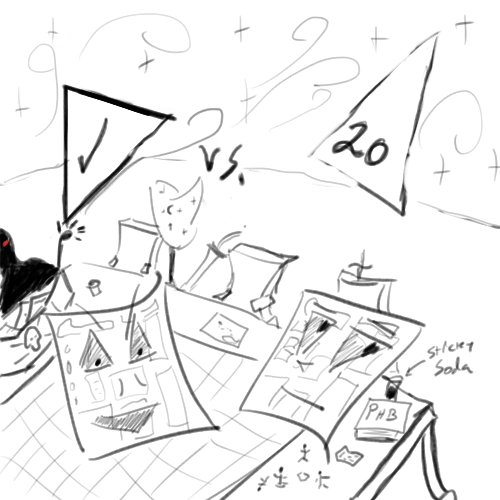
Short Answer: Characters aren’t triple decapitating their friends or themselves when the player rolls a 1.
Longer Answer: Adversarial style DMing makes this feat a slap in the face for the DM who is getting a rubber band effect of success being arbitrarily made into a failure.
Long Answer: Because the people who hate on the feat aren’t thinking about the game holistically. And I think it has to do with DMs who get a kick out of killing or setting back the characters in their game. In the defense of that stance, there is an attitude that floats around the DnD community about DMs being an enemy of the players and that a high character kill count is valuable to status. I am certainly not free of that attitude, and helped run a long-standing LARP that was based around surviving. Being a DM in a game where the fun is trying to survive weekly assaults from some source does involve being lethal and playfully antagonistic. But the players showed up for that game. They knew that it was the pitch and made their characters accordingly and thus fun was had, hooray.
It’s important to note that system wasn’t DnD, which I think isn’t a good game for that playstyle. Because Dungeons and Dragons lends itself to being a force to be reckoned with. A level one character is notable for their class level, which a vast majority of the population (theoretically) doesn’t have. Playing survival DnD would be voluntarily being a commoner, which sounds cool, but would require a lot of thought from the DM running it to make that playable. At which point, you might as well pick up a ready-made game that is just a different system.
But to make the point I’m trying to make a little more clear, imagine when a group of 5 people come together to play DnD but haven’t talked about what the elevator pitch is. If 2 think they’re rolling a regular high fantasy dungeon crawl, 1 assumes it’s a political/diplomacy game, 1 wants to play Settlers of Catan, and the DM has a sanity mechanic in place and is ready to start killing background family characters and watch their player-characters descend into sorrow and despair, they have a minor problem.
That was a convoluted way of saying if the DM wants to be antagonistic they should be transparent about that to the players before the game starts, and before they make characters ideally. Character creation for a player is a KEY aspect in how they will engage with the game, but I’ll write about that another time.
This is an article about the feat Lucky and so I should actually stick in that ball park.
So about what I mentioned earlier about it being a success-to-[expletive]you at the DM, what I mean is that for an adversarial DM who is seeking to torture their characters, a failure on the player is a success for the DM. And from what I have seen, there is an observable trend of house-ruling natural 1’s as a critical failure. I haven’t been keeping track of that so maybe it’s worth perusing the internet about calm discussions of DnD mechanics. Hah, I like my humanity.
So a player rolls at a natural 1 in combat. Oh no. The buttery katana handle slips through the grip of the veteran samurai and goes flying in a random, yet lethal arch that hits their friend, their dog, their arm, their honor, and their family two kingdoms away.
‘AHA!” says the samurai player. She activates the Lucky feat and boom. She just saved at least 3 lives. The DM who was just marinating in the would-be pain of the samurai got a reality check hard. And can get 2-more reality checks before the next long rest.
This is an incredibly exaggerated argument, so please take it with a grain of salt. But let’s look at what Lucky offers. For an ASI, a character gets to roll the dice another time before the DM calls success/failure. This even works when a character has disadvantage, and thus allows for an unprecedented 3d20 pick one (not necessarily the highest but would be wise in most situations to). This is the spot where a lot of people get hung up on. And yes it is an odd result that to my knowledge isn’t replicated anywhere else, even other luck-based features. But it is in theme with the general manipulations that luck features do. Halflings reroll a natural 1 and take the next result, portent allows a divination wizard to pre-roll some d20’s to use later as they see fit.
So fate-altering powers typically interact with the rolling process. This isn’t too much a surprise since that’s the vehicle for the game’s variable outcomes. While Lucky the feat doesn’t quite match up with existing mechanics, it isn’t so far out of the park with others.
Now I’m going to talk about my specific experience with the feat. Behind the DM screen, I have been pleasantly surprised at the benefits of Lucky. And I’m not talking for my player but for me, the DM.
I really like theatrics at my table. The rule of cool has me stronger than RAW does because I’ve been running games for years and I am not sustained off of the rules by their own. I get my kicks out of awesome moments and so it makes sense that I enjoy the effects of my players doing cool stuff. When the chips are down and ship hits the wall, a low roll can kill the mood. Especially if the dice just don’t want to cooperate that day and the player has been consistently rolling low. Lucky gives that much more agency in interacting with the game.
And in that dramatic moment when failure isn’t an option, Lucky adds a little padding to the situation which bolsters my confidence behind the screen that I’m not going to have to kill a PC or figure out the deus ex machina that saves their behinds. Now I’m not against killing PCs, but it it’s extra work on my shoulders that I’d rather be spending elsewhere.
A metaphor I use to describe my philosophy of DMing is that I’m in a car with my players. They are sharing the steering wheel between them, and I sit in the back getting chauffeured around as I describe to the (blind) drivers what is around them. If we hit a pothole, lose a tire, get shot at, I’m in the car with them. When we stop for gas, call it a night, or have to pull over to bury a body, I’m part of the team that does the effort.
In this same metaphor, an adversarial DM isn’t in the player’s car. They’re driving blind and figuring out directions out of the bumps with the curb, the potholes, and the pedestrians they take out along the way. In fact, the DM is a sick rigged out semi with 3 V12 engines blasting trying to run the players off the road. It’s exciting and awesome, but requires balancing on the DM’s part to not just stack the odds to great. Otherwise that’s just a slaughter and not great.
I suppose continuing this, nothing is stopping the DM-in-the-car from producing that exact scenario, which is probably more accurate to what I do. ‘Hey y’all, just so you know there is toootally a huge rig trying to tailgate you into the nine hells. What do you do?’
Wherever the DM sits is where they sit. And I’d be willing to guesstimate that where they sit is related to why they DM. And Lucky gives the players some agency outside of the regular bounds of the game to manipulate their situation. As mentioned, a DM who hit the player’s car with a harpoon having to suddenly retcon that because of Lucky is probably a bit jarring for the typical experience in that seat. And because ASIs/feats aren’t deeply coupled with the core essentials of a character (it is a variant rule), it is easy to notice as a culprit with little reason for being there.
So beyond metaphorical Mad Max scenes, the reason why your DM is behind the screen might be identifiable by their reaction to Lucky. From what I can see the major reasons to dislike Lucky are because it doesn’t resemble other rules in the books, and that it provides too much agency for the player outside of the game’s boundaries. A negative reaction to the feat might provide insight that your DM likes rules or doesn’t like having their authority stepped on.
And I’m going to immediately say that the last point is valid. The universe is a sacred power of the DM’s, and that authority being ignored is a big deal. But the line will be drawn in different places based on how much a DM has thought about the situation.
And again, I’ll defend that there isn’t anything wrong with a DM liking their rules. Consistency is how we get nice things like easy times abstracting rules that aren’t explicitly written. It’s important for DMs getting the air under their wings to be able to count on the rules to act as a foundation for them to build experience with. That’s why certain rules are flagged as variant, because they add unpredictability and complexity into the formula and can be more difficult for a newer DM to handle.
This originally was going to be a hater-post on the people who are against Lucky. Maybe I’ll still get there. But for today, I’ll say let the players have their feats. And if you’re adamant about being an enemy-DM then just let the blood of a Lucky character be more prestigious, not a barrier to your own fun.
 The Integral DM